Climate Change's Potential Impact on Major Tobacco-Producing Regions
In February 2019, I stopped my car on a red dirt road in Pinar del Río Province, western Cuba. Beside the road, a curing barn held cigar wrapper leaves that had not yet fully changed color. The local technician accompanying me said twice in Spanish, "lluvia fuerte, viento fuerte" — heavy rain, strong wind. He was not complaining about the weather; he was explaining why that season's seedbeds were nearly two weeks behind schedule. The soil and microclimate of Vuelta Abajo have been celebrated by the cigar world for over a century. The ideal growing season temperature is roughly 20–28°C, the average growing season temperature is often quoted around 25.5°C, relative humidity can reach over 70%, and annual rainfall often exceeds 1000 mm, with distinct wet and dry seasons. These numbers sound "just right." But what tobacco fears most is not a slow creep in average temperature — it is the disruption of rhythm: a rain that collapses seedbeds when it should be dry, or drought that prevents irrigation when transplanting should occur.
I later took the same set of questions to the Yaque Valley in the Dominican Republic, the tobacco fields of Rio Grande do Sul in Brazil, and several dry-hot valley flue-cured tobacco areas along the border of Yunnan, China. The conclusion became increasingly clear: the core impact of climate change on tobacco regions is not "whether it can still be grown," but "whether the same leaf quality can still be produced according to the old calendar." Yields can sometimes be maintained through irrigation and acreage expansion, but aroma, oil content, leaf surface integrity, and the curing window often collapse first.
Below is a region-by-region account. The numbers and events come from cross-referencing public reports with field conversations; the judgments are my own.
I. Cuba's Vuelta Abajo: The microclimate on the altar, first torn apart by "rhythm disruption"
Vuelta Abajo sits between mountains and plains, with mineral-rich red soil, and is the geographic origin of many Habano materials. Textbooks will tell you: at least about 8 hours of sunlight, adequate moisture, high humidity, and moderate temperatures. Real farming is more complicated — from seedbed to field to curing barn, any sudden shift in humidity at any stage can leave scars on the leaf surface.
Around 2019, media including CNN had already documented Cuban tobacco farmers confronting discussions about climate change: experts were concerned not only about hectares but also about quality. The more recent 2025–2026 growing season has put the problem into hard numbers. According to Cuban reports, as relayed by industry media, Vuelta Abajo saw approximately 11,426 hectares actually planted — better than the previous year, but significantly below the initial target of 14,000 hectares; heavy rainfall in September alone washed away about 19,000 seed plants, and drought disrupted the northern planting schedule. Unstable power supplies coupled with irrigation demands further fragmented an already tight agricultural calendar.
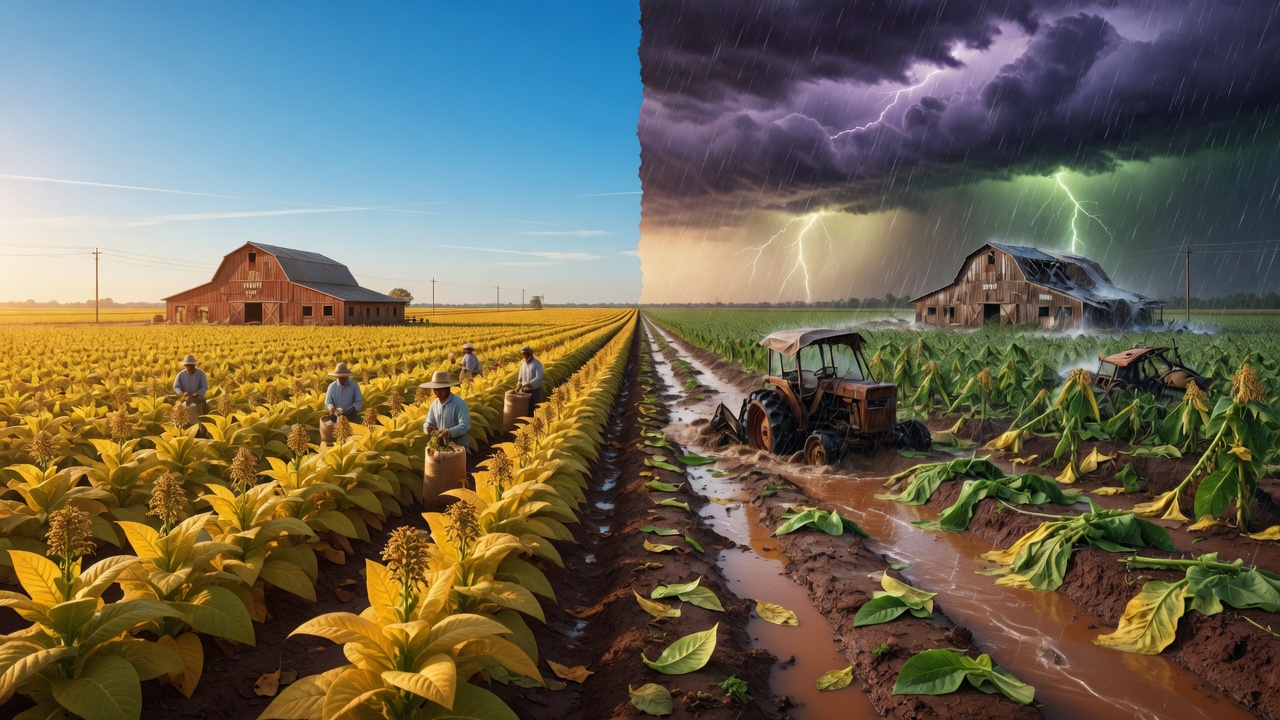
My personal view: the real risk for Cuban cigar leaf is not that it will "become too warm to grow" — a short-term rise of 1–2°C in average annual temperature may not immediately push the 20–28°C comfort zone completely out of reach; the true danger is extreme precipitation and drought alternating within the same growing season. Seedling stage fears waterlogging and disease; transplanting stage fears broken soil moisture; curing stage fears humidityloss of control leading to mold or "baked-out aroma." The mountains' rain-shadow advantage shrinks under "abnormal intensity rainfall."
There is another layer rarely written into marketing brochures: Cuba's production area infrastructure resilience is relatively weak. Solar irrigation is advancing, but when both the power grid and fuel are tight, farmers have less room to manage "staggered water use." A quality-oriented region, once forced to compress its agricultural calendar, sacrifices its finest wrapper and high-grade filler grades first — not just "whether there are leaves to sell."
If someone asks me: will Vuelta Abajo still be the altar in ten years? I would say — the brand narrative remains, the soil and variety genetics remain, but the year-to-year variability of usable high-quality leaf will increase, and buyers will more frequently hedge price differences between "classic years" and "mediocre years." That is not romance; it is supply chain mathematics.
II. Dominican Republic: The irrigation civilization of the Cibao—Yaque Valley, more resilient than Cuba, yet still fears the "dry-wet double strike"
The Dominican Republic's main cigar tobacco belt runs through the northwestern to north-central Cibao system, with the Yaque Valley often compared to Vuelta Abajo: on one side the Cuban altar, on the other an industrial-grade premium base on the opposite side of the Caribbean. The valley's internal variation is enormous. Plots at the foot of the Cordillera Septentrional have deeper, richer soil; afternoon mountain breezes can temper the day's heat. The more arid northwest zones rely heavily on irrigation canal networks. The industry often describes the valley's average annual temperature as falling roughly into a comfortable 22–31°C band — which sounds stable, but actually anchors that "stability" on water and wind.
I have seen those two-to-three-acre smallholder operations around Villa González: people in the fields, leaves on the ridges, irrigation ditches like blood vessels. The Navarette direction is drier; without canals, there is almost no commercial tobacco land. The climate narrative here differs from Cuba: the Dominican Republic has woven artificial water networks into its tobacco geography earlier and more deeply.
How does warming strike? I break it into three cuts:
The first cut hits evaporation and irrigation costs. Rising temperatures raise crop water demand and canal system losses; if smallholders face electricity or fuel price fluctuations, it directly affects whether they dare to transplant at optimal soil moisture. The second cut hits the loss of afternoon cooling. If mountain winds and cloud cover become "lazy" during heatwave years, leaf surface heat stress will increaseinstability intar precursors and stress-induced secondary metabolites, raising the probability of "harsh, astringent, thin" profiles after curing. The third cut hits the advancing pest and disease window. When warm nights lengthen, fungal and aphid problems often arrive earlier, consuming pesticide and labor budgets ahead of schedule.
Compared to Cuba, the Dominican Republic has thicker buffers: irrigation, variety introduction (including long-termdomestication of Cuban germplasm systems in local conditions), and export-oriented processing plant standards are more "industrialized." I believe the Dominican Republic over the next 10 years is more likely to be "expensive" rather than "leafless" — premium years become pricier, mediocre years are managed through blending. But if consecutive seasons of "storm-flooded canals plus drought-borne supply disruption" occur, the valley will reshuffle internally: foothill fertile plots command higher premiums, while drier marginal plots either upgrade to drip irrigation or exit premium leaf production for coarser uses.
One detail worth remembering: in the same valley, the Jacagua area is more humid and fertile, while the northwest is drier. Warming will not punish the entire valley evenly; it will amplify the grade differences between micro-plots. For blenders and buyers, this means the blanket label "Dominican leaf" will become increasingly unreliable — specific sub-regions and specific years must be specified.
III. Brazil: The "elephant" of global tobacco leaf, half its harvest staked on the temperament of one state's rainy season
Brazil is one of the world's major tobacco leaf producers and exporters, supplying both industrial cigarettes and parts of the cigar supply chain. Public industry analyses often note: about half of Brazil's harvest is concentrated in Rio Grande do Sul, and that state's rainy season is becoming harder to forecast. Some institutions, using risk tools, have labeled the 2025/2026 season's excessive moisture risk as moderate, and historical records show that drought risk has also been high — excessive moisture and drought knocking on the door in turns is the most typical climate portrait of Brazil's tobacco regions.
Brazilian tobacco farmers operate differently from Cuba's premium cigar growers. Operations are larger, with heavier mechanization and contract farming, and are extremely sensitive to "per-hectare yield and delivery grade." If the rainy season arrives early or extends, it directly collides with the transplanting and harvest windows; excessive moisture raises root hypoxia and leaf disease risks, while drought forces irrigation investment and may depress leaf area. For international buyers, when Brazil shakes, global tobacco leaf spot and futures sentiment shakes along with it — because of its sheer volume.
My personal view leans cautious: Brazil does not fear "production loss" in the short term; it fears "quality volatility plus logistics and price pulses." The industrial implication of climate change here is first that procurement managers must revise safety stock strategies, and only second that agronomy manuals need updating. If Rio Grande do Sul continues to suffer "rainfall pattern extremes," the growing belt may undergo internal northward shifts, altitudefine-tuning, or variety replacement — but multinational tobacco trade will not immediately find a replacement country of equivalent volume.
Additionally, labor heat stress is moving from "occupational health papers" into field reality. Studies have discussed the link between global warming and heat-related illness risks among tobacco farming laborers. Brazil, like other tropical-subtropical tobacco regions, faces a situation where if the harvest peak coincides with a heatwave, labor availability becomes a hidden capacity bottleneck. Machines can cover part of it, but not all of the fine harvesting work sensitive to leaf damage.
If I am allowed only one sentence to characterize Brazil: it is the "systemic node" of global tobacco climate risk — not the most delicate, but the one most capable of amplifying local weather into an international price signal.
IV. China's Yunnan: The "temperature, light, and water mismatch" of flue-cured tobacco, hidden deeper in seasonal alignment than in the Caribbean
Yunnan is not the center of the cigar narrative, but it is a key corner of China's flue-cured tobacco map. The climate logic here differs from the Caribbean's wet-dry season pattern. Extensive domestic research repeatedly emphasizes Yunnan flue-cured tobacco's uniqueness: the early field stage tends to be more sunny, less rainy, and warmer; the later stage tends to be less sunny, more rainy, and cooler — this "front-back contrast matching" is itself a quality code. Once warming rewrites any part of it, chemical composition and aroma precursors will drift.
Provincial-level climate change impact assessments indicate that against the backdrop of global warming, Yunnan shows an overall warming trend in average temperatures and an overall decreasing trend in annual precipitation, with effects on agriculture and biological resources. Station analyses for Kunming's flue-cured tobacco field growing period also show significant temperature increases (some studies give a warming tendency on the order of about 0.018°C/year), slight precipitation decreases though not always significant, and so on. Studies of the suitable area for oriental tobacco point to critical limiting factors in winter-early spring precipitation, sunshine, and Marchaverage temperature — showing that even "dry-hot valley oriental tobacco" is extremely dependent on month-scale climate distribution, not annual averages.
In southern and western Yunnan tobacco areas, I have heard technicians' two most feared phrases: first, "vigorous growth meets persistent overcast rain," and second, "maturation period days too hot, nights not cool enough." The former rots leaves, invites disease, and complicates curing; the latter makes aroma quality and oil content prone to being "floaty." If warming raises nighttime minimum temperatures, it compresses the diurnal temperature range — which is not friendly to the formation of many high-quality tobacco traits. Studies in Henan and other Chinese tobacco regions have also observed the influence of maturation-period maximum temperatures and diurnal range changes on chemical quality; Yunnan simply places the problem within a more complex plateau-monsoon context.
My judgment on Yunnan: warming will not suddenly make Yunnan "unable to grow tobacco," but it will force suitable areas to reshuffle along altitude and slope aspects. Low hot valleys may become hotter, drier, and more pest-prone; mid-to-high altitude plots that were originally cooler may become "more suitable" for a period, then cross the threshold again in the next round of warming. For industrial raw materials, this meansbase layout forblend leaf must adopt a 5–10 year dynamic perspective, rather than assuming a given county will forever be the "representative of theqingxiang (fresh aroma) type style."
On the operational level, Yunnan tobacco farmers are already skilled at "seizing the season." What will become more expensive in the future are: facility-based seedling cultivation, precision irrigation, disease early warning, and the curing process's ability to salvage anomalous fresh leaves. Whoever can still cure "anomalous fresh leaves" into stable grades will hold the pricing power in an era of climatevolatility.
V. Cross-cutting Mechanisms: What exactly does tobacco fear from warming?
Laying out the four regions, the mechanisms converge to a few points, not a hundred adjectives.
1. Temperature thresholds and nighttime warming.
Premium cigar leaf is often placed in the roughly 20–28°C comfort narrative; flue-cured tobacco has more complex stage-specificsuitable curves. Brief daytime highs can sometimes be endured with irrigation, but persistently warmer nights alter dry matter allocation and aroma accumulation — this is the slow variable I worry about more.
2. Precipitation shifting from "total quantity" to "violent distribution."
Cuba's 2025–2026 seedling losses, Brazil's dual risk of excessive moisture/drought, the Dominican Republic's canal-zone engineering dependence, and Yunnan's seasonal mismatch — all follow the same logic: normal annual rainfall can still be a bad year — rain falling on the seedbed or during the harvest week.
3. Extreme events directly cutting acreage.
Hurricanes, localizedextreme torrential rain, andconsecutive drought can slash "planned hectares" to "actual hectares." Cuba's below-target planting area is a product of climate plus energy constraints.
4. Pests, diseases, and heat labor.
Warmth and humidity extend the infection window; heatwaves compress effective working hours. These two factors rarely appear in cigar advertisements yet determine whether the field can follow theprocess schedule.
5. Curing and fermentation amplifying upstream errors.
Tobacco is not finished once harvested. Curing barns, fermentation rooms, and aging warehouses are all sensitive to humidity. Leaves already knocked off course by climate in the field are harder to salvage downstream. That is why I keep saying: the quality chain breaks earlier than the yield chain.
Some may also ask: could warming benefit higher-latitude/higher-altitude new regions? There will be localized opportunities, but tobacco — especially cigar leaf with style memory and brandblend leaf — is deeply tied to microbial communities, soil, andcraft tradition. New regions can grow leaves, but may not produce "a style the market recognizes." That is why I refuse to write "northward expansion" as an optimistic fairy tale.
VI. How the Supply Chain Will Change: My Clear Positions
Position one: Over the next decade, the main thread of global tobacco climate issues is "rising variance," not "collective disappearance of major producers."
Cuba, the Dominican Republic, Brazil, and Yunnan will all still be there, but the variance in usable quality leaf between years will widen. Procurement, inventory, blending, insurance, and contract farming terms will matter more than opening new virgin land.
Position two: The premium cigar chain is more fragile than thecommodity-grade flue-cured tobacco chain.
Because the former depends more on microclimate and leaf aesthetics, while the latter depends more on industrial usability and cost. Brazil's tremor has a broad impact surface; Cuba's tremor affects premium and legendary narratives; Yunnan's tremor affects base-regiondiscourse power in Chinese-style cigarette formulations.
Position three: Adaptation technology will stratify.
Entities with capital for drip irrigation, shade netting, facility-based seedling cultivation, disease models, and solar water pumps will capture more profit from "abnormal years"; purely rain-fed smallholders will be squeezed out of the premium supply pool or relegated tovolatilitybuffer zone. The Dominican Republic and Brazil are structurally more consolidated than Cuba's smallholder scene, but Cuba's irreplaceability makes the market willing to pay forvolatility — a kind of distorted resilience.
Position four: Do not expect a single "climate-resistant variety" to solve everything once and for all.
A variety can resist some stress, but it cannot change the humidity demands of the curing process, nor consumers' path dependence on classicproducing region flavors. Agronomy, water infrastructure, energy, andwarehousing must all change together.
Position five (for downstream consumers and industry observers):
If you care about nicotine replacement pathways such asnasal nicotine replacement therapy, the climate risk in upstream tobacco leaf may seem "one layer removed," but it still transmits indirectly through regulatoryraw materials, extraction costs, and agricultural product prices. The more harm-reduction and alternative products emphasizeingredient stability, the less they can ignore agricultural-endvolatility. What is stable is not a moral slogan; it is batch-to-batch consistency.
VII. Where I Place My Bets for "Possible Changes" in the Four Regions
- Cuba: The gap between planting area targets and actual completion will recur in storm-drought years; high-grade wrapper supply will become morevintage year-dependent; energy and irrigationretrofitting determine the floor.
- Dominican Republic: Internal valley differentiation will intensify; irrigation zones trade cost for stability; export blending capability is its greatest climate insurance.
- Brazil: Will continue to serve as the global volume-price anchor, but Rio Grande do Sul's rainfall patternextremization will create periodic shocks; industrial customers will demand moreorigin diversification.
- Yunnan: Suitable areas will reorganize along altitude and river valleys; the classicqingxiang (fresh aroma) type counties may be rewritten by "temperature, light, and water mismatch;" curing and base dynamic adjustment capability determine industrial raw material security.
The phrase I heard on that Cuban red dirt road in 2019 — "heavy rain, strong wind" — is not outdated when set beside the 2026 hectare figures and seedling loss reports. Warming is not a verdict stamped on a single day; it is a slow slope that tears the farming calendar increasingly to pieces. Tobacco, a crop that writes "flavor" into its leaf cells, is particularly cruel to a shattered calendar.
Let me end with a judgment I am willing to stand by: Anyone still doingproducing region planning based on "average annual temperature" is already one step behind; what truly matters is the rain intensity in the seeding week, the nighttime temperature in the maturation week, the wet-bulb temperature in the curing week, and the frequency with which extreme events punch through the planned area. Region names can remain unchanged for a century, but the battle lines inside those regions are already being redrawn.
关键数据分析
Cuba vs Dominican Republic: Climate Vulnerability Comparison
Cuba (Vuelta Abajo)
High microclimate dependency; weak infrastructure resilience; quality-oriented but thin buffer
Dominican Republic (Cibao—Yaque Valley)
Early artificial water network coverage; deeper variety domestication; thicker industrial buffer